Manual coffee grinders are regaining popularity. Not only among coffee lovers, but also among tourists and premium coffee brands.The market has undergone significant changes in recent years. Certain grinders appear high-end externally, yet their grinding effectiveness is underwhelming after a few months of usage. Some maintain consistent performance over the years.
So where is the real difference?

Consistent Grinding Changes Everything
A grinder can look beautiful and still make bad coffee.
What matters most is grind consistency.
When the coffee particles are inconsistent, controlling extraction becomes challenging. Finer powder extracts rapidly and introduces bitterness. Big particles extract too slowly and result in coffee that is dull or acidic.
This problem is clearly evident in espresso and pour-over brewing.
Numerous inexpensive grinders possess unstable internal designs. While grinding, the shaft may shift slightly or the burrs can become misaligned. When this occurs, the size of the particles varies.
Effective manual coffee grinders address this issue with structural design. Improved bearings, more precise assembly tolerances, and reinforced center shafts all contribute to maintaining burr stability during grinding.
The difference is typically noticeable right away. The rotation of the handle feels more fluid. The vibration is reduced. Milling feels more precise.

Burr Burr Quality Matters More Than a Lot of People Realize
The burr is the core of a coffee grinder.
Inexpensive grinders typically utilize imprecise burrs. Although the burr material appears promising theoretically, inadequate machining still results in inconsistent grinding outcomes.
Ceramic burrs are popular due to their resistance to corrosion and lower production costs. They perform effectively in moist conditions.
However, ceramic burrs may break when subjected to impact. The grinding speed is generally more sluggish too.
Premium manual coffee grinders typically utilize stainless steel burrs instead. Precision stainless steel burrs maintain their sharpness longer and create more consistent coffee grounds.
Yet just having material is insufficient.
Burr geometry matters just as much.
Tooth angle, cutting pattern, and bean feeding structure all affect the final grind result. Small design changes can create very different particle distributions.
That is why experienced coffee grinder manufacturers spend a long time testing burr structures before mass production.
Burr geometry matters just as much
Tooth angle, cutting pattern, and bean feeding structure all affect the final grind result. Small design changes can create very different particle distributions.
That is why experienced coffee grinder manufacturers spend a long time testing burr structures before mass production.
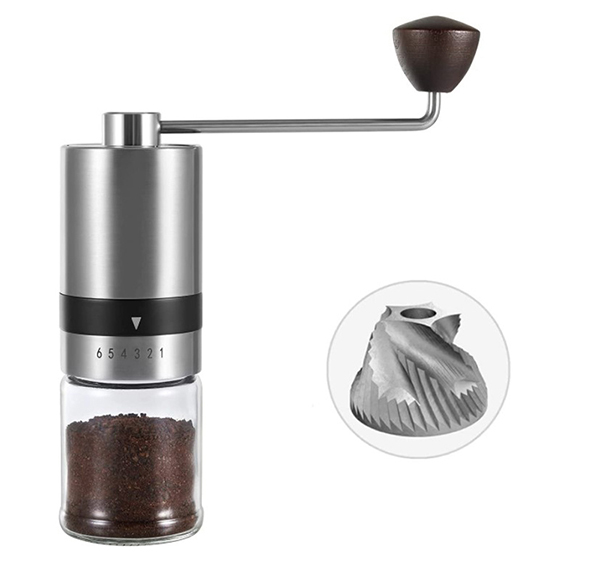
Internal Stability Matters More Than Exterior Design
Many consumers first notice appearance. Manufacturers care more about internal stability.
This is where cheap grinders usually cut costs.
Some entry-level grinders use single-bearing structures or weak center shafts. After extended use, grinding stability drops noticeably.
Premium grinders often use dual-bearing support systems. The burr stays aligned during the entire grinding process.
Body materials also affect long-term performance.
Plastic housings reduce cost and weight, but they are more likely to wear out or deform over time.
Aluminum alloy and stainless steel provide much better rigidity. This is why more premium portable coffee grinders now use metal bodies.
Aluminum alloy is especially popular because it balances portability and strength very well.

Adjustment Precision Is Also Critical
Different brewing methods need different grind sizes.
Espresso requires extremely fine adjustment. French press needs much coarser particles. Pour-over sits somewhere in between.
Low-end grinders usually have limited adjustment control. Sometimes one click changes the grind size too much.
Higher-quality manual coffee grinders offer more precise adjustment systems.
Some use stepped adjustment for easier repeatability. Others use stepless adjustment for finer espresso control.
For specialty coffee users, adjustment precision becomes increasingly important.

Portability Has Become a Significant Industry Trend
Portable coffee culture has grown far beyond camping.
People now carry grinders to offices, hotels, road trips, and outdoor activities. Because of this, portable grinder development has become a major focus for many brands.
Modern portable coffee grinders usually focus on:
Compact structures
Foldable handles
Lightweight materials
Easy cleaning
Better travel durability
But making a grinder smaller also creates engineering challenges.
A compact body makes burr alignment harder to maintain. Structural rigidity becomes more important.
This is one reason experienced coffee grinder manufacturers stand out from low-cost suppliers.
Chinagama coffee grinder manufacturer has focused on portable coffee grinder manufacturing for over 20 years. We develop ODM manual coffee grinders and rechargeable electric coffee grinders for global brands, including Bialetti.
The Future of Manual Coffee Grinders
Consumers now pay closer attention to grinding quality than before.
They want better consistency, smoother operation, premium materials, and portable designs at the same time.
This pushes manufacturers to improve burr systems, structural stability, and user experience continuously.
In the future, portable grinders will likely become smaller, more precise, and more integrated with travel brewing systems.
Conclusion
A quality manual coffee grinder is not determined by its looks alone.
Consistency in grinding, precision of burrs, stability of structure, and accuracy of adjustments are all important.
For brands seeking a dependable coffee grinder producer, engineering expertise frequently holds greater significance than pricing by itself.
An effectively crafted grinder produces superior coffee, extends product lifespan, and significantly enhances user satisfaction.